Please take a moment to enjoy this beautiful video about our mission.
God Bless You!
Please take a moment to enjoy this beautiful video about our mission.
God Bless You!
One of the dangers of living in a culture so tolerant of every kind of self-expression and behavior is that the moral dimension of our own thoughts and actions becomes bleached out. We can eventually stop considering things from the perspective of whether they are good or evil, right or wrong, and instead consider whether we will offend another person if we say so.
This is not an age where we want to lose the edge in our discernment. If we do, we can easily end up in dangerous positions, dangerous especially to our souls. One of the things that is more and more prominent is the number of people who become entangled in occult activities (especially witchcraft and New Age) without even recognizing it at first. This is because doors in the spiritual realm get opened. Certain evil spirits read that as an invitation. They respond by quietly suggesting and encouraging directions that lead to even deeper involvement.
Within the last 6 months, I’ve encountered at least four women who became involved online with New Age, witchcraft, and soft porn (by way of providing material for it on one of the popular websites). Each woman admitted some degree of shame for being involved in what they were doing. But each woman has also found it hard to quit because the money to be made from those activities is so “good.”
There are reasons why God forbids such things. This is critical to remember because the stakes are so high. We have to get this right if we don’t want to find ourselves fulfilling Jesus’s warning about gaining the whole world but losing our souls. Nothing in this world is worth that. And it would be good if we who are strong in our faith weren’t afraid to take definitive stands so that no doubt remains in the mind of another about the seriousness of our choices.
I knew a very holy Priest who occasionally had to tell people seeking his direction that if they proceeded forward on a certain path, he would stand against them at the judgment seat of God. Why? Because he wanted them to clearly understand when they were making a choice that was displeasing to God and against his commandments. This was often in the realm of sexual morality. But it also included things forbidden to us that we lightly dismiss, like seeing mediums, getting psychic readings, practicing certain “healing” techniques, taking certain tonics, wearing talismans, “praying” with spells, etc. These are all things directly and indirectly forbidden in Scripture.
We are better served when we know something about how these different “practices” have permeated many of our mainstream activities, entertainment, and even our preparations for death. One of our Sisters, while attending a dying family member, encountered a hospice service that used Reiki to help the patient with pain and anxiety. Reiki has its roots in Japanese Buddhism and is a modern revival of ancient practices.
For those who might not know, Reiki is promoted as a Japanese healing technique that relies on channeling universal energy. There is a practitioner involved who places hands gently near or above the body and purportedly manipulates or changes energy channels to promote healing, etc. This is not compatible with Christian or Christ-centered beliefs that center healing in the Divine Physician and the power of Christ at work in our lives. The problem with many of these types of practices is
1. They are not based in or backed by authentic science.
2. Oftentimes, the “energy” which is referred to in these types of practices is deeply manipulated by spirits that are not benevolent spirits.
One of the best resources for finding out about the roots of things you may encounter and whether they are compatible with our faith is found at the website www.womenofgrace.com. Look for the tab on the right side of the page with a heading of New Age, underneath which is an alphabetized blog index run by Sue Brinkman, a seasoned journalist who offers a definition and the Church’s position on everything from hypnosis to the most obscure practices you might encounter today. There you can find anything you need to know about New Age, Occult, or questionable practices in general.
If the Scriptures remind us that it is possible to perish for lack of knowledge (Hosea 4:6), then not knowing what you are dealing with can be extremely dangerous. Form and sharpen your powers of discernment. They are needed today more than ever.
Finally, the simple solution to most of these questions is to keep Christ at the center of your life and refer everything to Him and the teachings of your Catholic faith.
A dear friend shared that when her youngest was about 5 or 6 years old, her siblings were talking one day about the house they lived in and whether it was haunted. Her little one walked in, listened a bit, and then declared: “There are no ghosts in this house. Only the Holy Ghost!” Make sure He’s the main Resident in your “house” too!
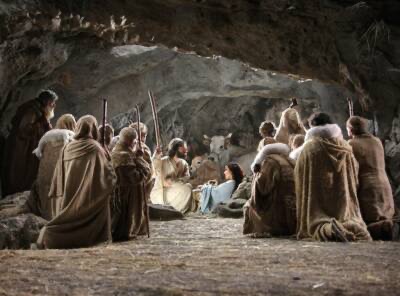
When Adam and Eve were expelled from the Garden, the contrast between what they had lost and what they were left with must have been overwhelming.
Whether one looks at the beginning of history biblically or strictly from a scientific point of view, without the spiritual perspective, it’s reasonable to surmise that humankind’s first home outside Paradise would have been a cave. Archaeologists have verified the authenticity of cave paintings dating back to prehistoric times, suggesting that caves were the first natural shelters for our ancestors.
One can easily imagine that this “first” home would’ve been something providentially prepared by the elements. It offered protection, a place for rest, safety, solidarity with others, and, in general, space for regular human activities. Though there were drawbacks, comfort was not the predominant issue for our early ancestors. Survival was the constant pressing demand. The concept of leisure was probably not entirely compatible with their existential reality. However, they were already engaged in primordial activities that, in our day and age, are often associated only with hobbies or leisure but for them, were activities (painting pictures of their life, on the walls) that expressed deeper, more significant realities, a way of thinking out loud, of visualizing themselves from outside themselves, taking on the larger perspective needed for growth and development as they became increasingly able to symbolically represent the world around them in order to take back command of creation again.
There were many fundamental problems to solve in the beginning, such as finding food sources, securing safe habitats, and determining how to manage the darkness that now invaded their days with regular timing. (From a biblical perspective, Adam and Eve before the Fall would not have had to contend with the unknown threats that lurked in the night, as Revelation suggests Paradise restored (and likely original Paradise as well) does not require lamps or the sun, because there the Lord God is its light.
Sin changed our hearts. Sin threw us into a cave. Sin changed life from light and constant communion with light to an ever-present battle with darkness and all the threats that live there.
Because the encounter with our first enemy did not go well, we landed in a pit we could not escape ourselves. The loss in that attack catapulted us from harmony and abundance into a primitive, often brutal fight for survival with eternal consequences. We went from a place of elevated status with God as His friends, to estrangement and the very real possibility of never being able to have intimate communion again with our Father and Lord!
This is one way to ponder the mystery of Christmas, which approaches. God has such a depth of love for us that He comes in the Person of Jesus, even entering the depths of the primitiveness into which sin has cast us. And it is undoubtedly primitive, but at the same time, the link to God in His image and likeness, which makes us different and superior to all other creatures, remains intact. G.K. Chesterton, in “The Everlasting Man,” expresses it thus:
“The human story began in a cave…the second half of human history which was like a new creation of the world, also began in a cave…it was here that a homeless couple had crept underground with the cattle when the doors of the crowded caravanserai had been shut in their faces and it was here beneath the very floor of the world that Jesus Christ was born. God also was a Cave-man, and had also traced strange shapes upon the wall of the world, but the pictures that he made had come to life.”
Jesus, the firstborn of all creation, now seeks to enter the cave of our own hearts. He will seek shelter there this Christmas. In the cold, dark night, He will be looking for the opening. He will be looking for warmth and welcome! He will be looking for simplicity and love. He will be looking for the wonder and guilelessness of the Shepherds, the expectancy and reverence of the Magi, and the joy and witness to heavenly glory of the angels. Most of all, He will look for the humble, protective love of Mary and Joseph, a love that will never let go, that will hold Him close within, even through the darkest hours, while He changes the “place” we live back into an “earth” we, He, and all of us, can dwell in together forever. May your own heart be the chosen and favored spot of the Babe who brings beauty, light, love, and joy back to a world in exile; who makes it a fit dwelling once more for the Redemptive, transcendent, Trinitarian love the Babe wants to gift to all of humanity. We wait with anticipation to see what He will write on the walls of our own hearts this Christmas.
2. The quote by Chesterton points to the fact that when the Lord speaks, or in this case “draws”, he is creating. His words and actions are always life-giving, always creative. The more we are raised out of our fallen condition the more our own words and actions share in this creative power of the Lord. Have you experienced the Lord working through you in this way?
3. What do you think the Divine Child is looking for in you this Christmas? What would you like to give Him and what will be the best way to do that?
4. Sin blocked out the light and gave us the night to contend with. Literally and figuratively. The night contains things the Lord wants to free us of. So, he came into our night to do that. What do you see as elements of the night the Lord has already healed you of?

Love for the Lost!
Just a few weeks ago, on October 19, 2025, Pope Leo XIV presided over a remarkable canonization. What made the canonization so extraordinary was the fact that the Italian priest, Bartolo Longo, had been heavily involved in Satanism and had even served as a satanic priest. But just as admirable as his conversion was the prayer, faithfulness, and love of his family, who never gave up on him, engaging whoever they thought could help him. One professor took him on and began to meet regularly with him, reminding him that, given the direction he was headed in, he would end up in an insane asylum and finally be damned forever. Bartolo recognized his state and agreed to see a Dominican priest who worked with him and brought him back into the Church.
Bartolo imposed harsh penances on himself to make up for the damage he had done, but nevertheless could not forgive himself. He struggled with despair of being truly forgiven by God. Then he came upon the words of Our Lady, ‘One who propagates my Rosary shall be saved.’ He spent the rest of his life promoting the Rosary and living out its mysteries, building a famous Basilica to Our Lady of the Rosary in Pompeii, as well as founding schools, orphanages, and various other works for the poor. He also wrote books on the Rosary, novenas, and prayer manuals. His reflections, in fact, are the source for the Luminous Mysteries, which Pope St. John Paul II gifted to the Church during his pontificate.
Two main forces animate the lives of all saints: love for God and love for neighbor, especially the lost. Jesus is seen almost always engaging with the lost because of His great love. There is nothing He is not willing to endure for them. And the saints, whether they are great theologians like St. Thomas, or missionaries like St. Francis Xavier, or mystics/contemplatives like the great St. Theresas, are exactly like this as well. Their love for the lost and their desire for the salvation of every soul move them to great heights of holiness, to profound union with Christ in His redemptive work. Even heaven seems oriented to the lost. The scriptures tell us that we’re surrounded by heavenly witnesses who, by implication, cheer us on, root for us, encourage us, and inspire us. And we know that all of heaven rejoices over the one soul that returns, versus the 99 that did not need to be saved.
One of the witnesses our present day needs is the presence of this kind of love, a genuine love for the lost, no matter the depths of darkness they may be in. We have all been saved and should be willing to do whatever it takes to bring others into that same light. But today, the divisiveness and judgment of the Pharisees seem to prevail in us.
Perhaps one of the reasons Jesus tells us not to judge one another, in fact to even love our enemies, is because it’s very difficult to love someone you’ve already judged. And love, not judgment, is our real mandate. We ourselves will be judged on how we love. We’re not going to be judged on the brilliance of our insight into other people or our profound assessments of their motivations and intentions. We are hardly in a position to be impartial about anything, given the strength of our own ego and our bias towards the negative, and given that we are so poor at seeing the goodness of the Father at work. We can hardly claim to be faithful followers of Christ if we do not comport ourselves as He did, nor carry the sentiments of His Heart toward all.
That is a challenge in a culture like ours, which constantly seeks to polarize people and keep them at odds with each other. Yet, for the believer, unless we recalibrate our own hearts to the love Jesus bears not just for us, but for all, we will not fulfill our real purpose in extending Christ’s saving love to all, nor bear fruit that will count for anything when our lives are weighed before the Lord.
What is the driving force of your life? What is the animating spirit? Because if the major animating force of Jesus‘s life, aside from His love for the Father, is love for the lost, then it should be ours also.
“What really matters in life is that we are loved by Christ and that we love Him in return. In comparison to the love of Jesus, everything else is secondary. And, without the love of Jesus, everything is useless.” St. John Paul II
That understanding is a light that people of today are literally dying to see.

It is a simple fact that our lives are lived out in the interaction between three realities: God, (including Mary, the angels and saints, the Church Suffering or Purgatory, etc.) ourselves, ourselves (including all of our human relationships) and the evil one (including the many fallen spirits that work with him). Each of these three realities is characterized by a certain spirit. For our purposes, we will consider the word spirit to mean: a particular way of thinking, feeling, or behaving.
God, of course, is characterized by the divine spirit; we are characterized by the human spirit, and often that means the fallen human spirit; and of course, the devils are characterized by a demonic spirit.
When evaluating an experience or happening, a spiritual diagnosis would examine the kind of spirit or spirits that predominate and whether there’s any evidence of good fruit. We can experience fluctuations or changes in our spirit in response to various inputs. Sometimes our spirit soars at signs of hope, discovery, or celebration. Sometimes it is discouraged and doubtful. There are many possibilities, but what we’re concerned with here is the predominant influence in our lives.
The prophet Simeon tells Our Blessed Mother that a “sword of sorrow will pierce her heart that the thoughts of many may be laid bare.” One of the general principles that flows from this is that suffering reveals a person’s true thoughts, their true heart, their true orientation in life, their true spirit. It is generally harder to hide or disguise one’s true feelings when suffering. The question we’re interested in here is what spirit is it that best expresses what we’ve really become inside ourselves. Dramatic events can be very revealing here.
A measure of your spirit can be found in weighing your reaction, your thoughts, feelings and belief in the light of sudden, dramatic events such as the recent assassination of Charlie Kirk. Did you feel horror? Sadness? Joy? Concern for all involved, etc. Were you happy, or were you truly shocked and mortified? Did you desire vengeance? Were you concerned about justice? What came out of your spirit when that happened?
In discernment, Spiritual theologians describe the characteristics of the divine spirit, the diabolical spirit, and the human spirit. God always moves us toward the good, whether directly or indirectly. The devil always moves us to evil, either directly or working through weaknesses and wounds we already have. The human spirit can be inclined towards either evil or good, depending on a number of factors, such as whether right reason or selfish desires predominate within us.
The signs by which we may know what spirit is operating are quite distinct from one another. Truth, gravity, enlightenment, discretion, humility, peace, confidence in God, flexibility of will, purity of intention, patience, suffering, self-negation, simplicity, and liberty of spirit, the desire to imitate Christ, and disinterested love are all marks of the influence and movement or presence of God’s Spirit.
Some of the marks of the evil spirit are lies, violence, nudity, bad language, cursing, blasphemy, separation, or isolation, accusation, hate, unforgiveness, rejoicing in evil, deceitfulness, destruction, stealing, or destroying another’s property, obsessions, extreme sensuality, envy and pride, spirit of falsity, morbid curiosity, Confusion, anxiety, and deep depression A spirit of pride and vanity, false humility, disobedience and hardness of heart, impatience in suffering and stubborn resentment, uncontrolled passions and a strong inclination to sensuality, hypocrisy, simulation, and duplicity are also some strong indicators of the demonic spirit at work.
In the context of recent events, we saw some people rejoicing over the murder of a person they disagreed with. Fr. Ripperger pointed out that this is the way demons behave. They rejoice when bad things happen. That, along with any other of the above signs in us, should be cause for serious concern.
The human spirit is always inclined to dissatisfaction. It is a friend of pleasure and an enemy of suffering. It inclines to anything that is compatible with its own temperament, personal tastes, and the satisfaction of self-love. It avoids humiliations, penance, renunciation, and mortification. It seeks success, honors, applause. It’s a great promoter of anything that will rouse admiration or notoriety. In other words, the human spirit tends to care only about its own egoism. – Sources: Fr. Jordan Aumaan, Thomas a Kempis
Sometimes, it can be difficult to discern between the human spirit and the diabolical spirit. But the spirit of God is easily discerned as distinct from either of them. Our challenge is to decide whether we want to be known for an ugly spirit or a transformed, godly spirit that is immensely attractive. Do we want souls to be saved or lost? The spirit we choose to live with will produce either good fruit or bad fruit. And that fruit, in the end, will witness for or against us.
2. Examples of. the human spirit at work?
3. Examples of the demonic spirit at work?
4. What would you like to cultivate more deeply in yourself? What kind of spirit would you like to be the mark of your own life?
If you had an ally who was superior to you on a number of different levels, and you were in a longstanding battle that you were losing, would you not engage your allies? Would you not implore them to take up your cause against your enemy?
There are numerous modern-day fantasies that draw on this theme, as evidenced by the superhero films that frequently appear in theaters. You see that common theme of creatures or beings who, at times, may even seem like misfits in the universe, coming to the aid of threatened humanity with powers that surpass ordinary human capacity. The characters may not be real, but the fight certainly is. And so is the need for help that comes from beyond the ordinary.
What is so fascinating is that we actually have such allies. The scope of their power and responsibilities is far beyond what we normally think. They, in fact, have intelligence and power far superior to our own, and in many ways rule realms that keep the universe moving so that it unfolds according to God’s will and His divine purposes. These allies, of course, are called angels. They are spiritual beings who generally do not manifest in visible forms unless necessary. In fact, one of the reasons they remain hidden so much is that if we saw them as they truly are, we would be tempted to worship them.
The angels are many, hierarchically arranged into nine choirs according to their different callings and responsibilities. They are, from the highest realms to the lower realms: the Seraphim, also called “the Burning Ones” who attend God’s throne and constantly praise Him with the highest love, the Cherubim, whose name means “fullness of wisdom”, and the Thrones, who represent God’s power and authority.
The second hierarchy or set of 3 choirs is the Dominions, the Virtues, and the Powers. The Dominions direct the lower choirs of angels in the execution of God’s plans. The Virtues are sometimes known as Guardians of the Cosmos because they oversee the natural and cosmic forces, the movement of heavenly bodies, and such things as the weather. The Powers defend the cosmos and, more specifically, humanity, from evil forces, threats, and influence, and work to maintain cosmic order.
The last three choirs of angels, or the third hierarchy, are those angels that are most directly involved with human beings and their affairs. This hierarchy includes the Principalities who oversee nations, cities, and communities. They assist earthly leaders and protect and guide institutions and/or groups according to God’s plans.
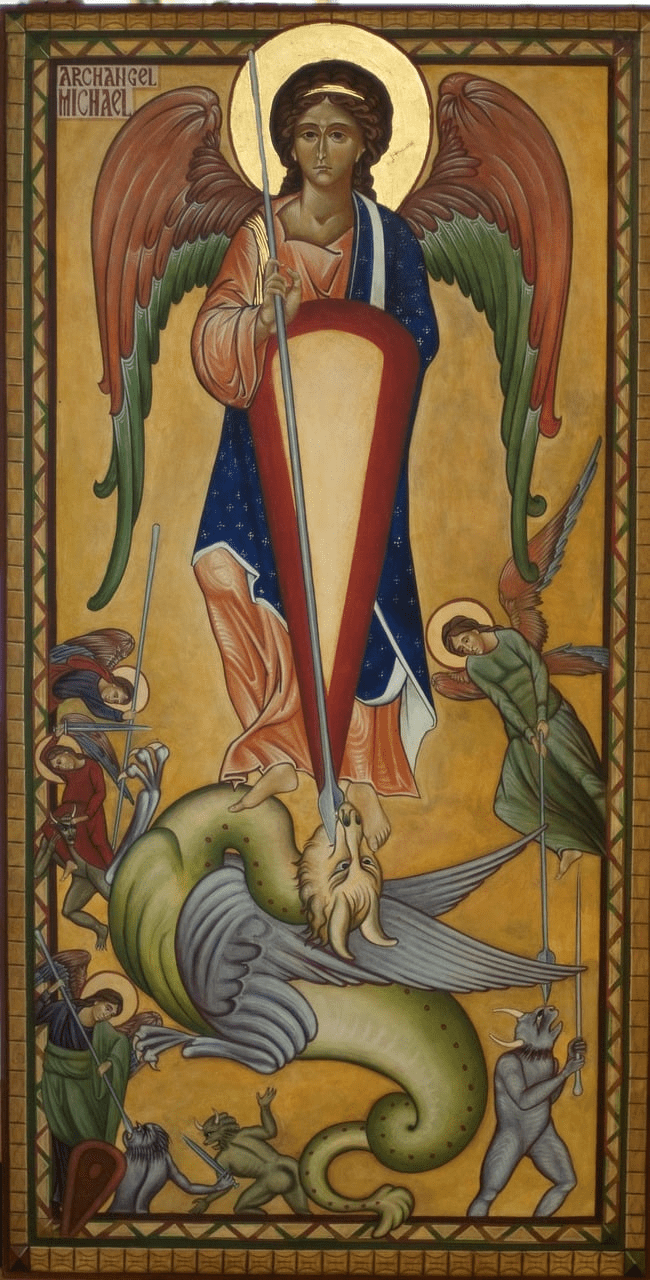
The Archangels are messengers who convey significant messages from God to humanity. Three of them are named in Scripture: Michael, Gabriel, and Raphael. And they are known, respectively, as “defender,” “messenger of the Incarnation,” and “healer.”
The final choir, the Angels, also known as the Guardian Angels, are the closest and most directly involved with humans. They watch over individuals, protecting, guiding, and communicating God’s love and grace.
Evil and malice can be overwhelming, and our experience can be one of helplessness in the face of it. It can seem so much more powerful and prosperous than the “handful” of people we see, struggling to be good and remain faithful to the Lord in the midst of fierce hostility and opposition. The words of St. Paul, that we fight not against flesh and blood but against principalities and powers, verify this feeling of littleness and weakness. We must remember that the fallen angels, angels who followed Lucifer in his rebellion against God, come from these choirs also, and move to counteract the good God intends in these realms. This is, properly speaking, the spiritual warfare that goes on all around us, mostly without our awareness, but real and terrifying nonetheless.
If you find yourself praying for our country, for certain nations and leaders, why not call on the Principalities? If you are concerned about threatening weather, or even “outer-space” movements of bodies, why not pray to the Virtues? If you are aware of the spiritual warfare going on behind the scenes, behind major developments for good and evil, why not engage the Powers?
Ours should be the story from 2Kings 6. The king of Aram, in his fight against Israel, is trying to capture the prophet Elisha, who is in the city of Dothan. Elisha’s servant panics when he wakes up and sees they have been surrounded overnight and are now overwhelmingly outnumbered by the enemy. But Elisha is calm and prays that God show his servant the invisible realms present so he can be assured of the victory God will win for them. His servant’s eyes are opened, and he sees the hills filled with horses and chariots of fire, the heavenly host vastly outnumbering the enemy. These heavenly warriors will be victorious in the fight for God’s people, against both visible and invisible forces.
This is no small comfort. It is one the early Christians were more than mindful of, and an awareness we need more than ever today. All you holy Angels pray for us and protect us! May God’s holy will be fulfilled!

Sr.AnneMarie Walsh is inviting you to a scheduled Zoom meeting.
Join Zoom Meeting on Monday, August 11, 2025 at 7:30pm Central, or 6:30pm, Mountain time
https://zoom.us/j/96923076562?pwd=XYsZpXX9296nzxJfAM0SM2pOsanabJ.1
Meeting ID: 969 2307 6562
Passcode: 178153
—

People are anxious about many things these days. When a person does not stay in a primary dependence upon God, it becomes clear quickly that any other dependency outside of God will lead to insecurity and an apprehensiveness that can take on a life of its own. Perhaps the most common dependency that people use to replace their dependence upon God is found in materialism.
There is a reflection of this in the fall in the garden. Up until the time of the fall, Adam and Eve were happily and unselfconsciously dependent upon God. With the decision to eat the forbidden fruit, they essentially detached themselves from God and attached themselves to the created world, drawn in by its beauty and seductive promises.
That is the nature of materialism. We pursue possessions, etc., because we see the good in them, but at the same time, we over-value them in relation to God to the point where they usurp His place in our lives. They become for us little gods or idols that are incompatible with trust in God. It is not possible to depend on or serve something outside of God while depending on Him at the same time, primarily because the goals of materialism fall so far short of the goals God has set for us.
Ideally, we should spend our time here on earth longing for and preparing for eternity, enchanted by the idea of it. But we know most of us don’t live our lives that way. We conflate material prosperity with blessings and success. Yet, there’s no place in the life of Jesus where you see this as a reality. In fact, Jesus purposely chose poverty to illustrate the opposite, that real riches are not to be found in the things of the Earth, the things that are passing away, but in heaven, where neither moth nor rust can destroy the true treasures that await us.
Jesus understood our tendency to try to serve both God and mammon. He clearly told us that it’s impossible to serve both; we will have one or the other as our master. In one, we find transcendence, transformation, and true worth. In the other, we encounter degradation and a state far below our dignity. Scott Hahn puts it succinctly in his book Reasons to Believe: “To pretend to serve God and the world is the same as to imagine that we can be both proud and humble at the same time. A vain dream!”
A striking and representative example of this struggle is found in the history of the Conquistadores, who came to the New World seeking gold, glory, and, in the case of the Spanish missionaries, to spread the word of God. The greed for gold often nullified the nobler witnesses that were present. It certainly had a negative impact on evangelization. Only Our Lady was able to salvage the work of the early missionaries through her appearances as Our Lady of Guadalupe. But this is nearly a universal struggle. It has marked the history of mankind from the beginning.
When the relations between the Aztecs and the Spaniards had come to a head and the Spaniards were being driven from the city (Tenochtitlan), the soldiers tried to escape under the cover of night in the middle of a rainstorm. The elite troops of the Aztecs discovered the attempted escape and engaged in battle with them. That night (June 30, 1520) became known as the “Night of Tears” because the Spanish soldiers were told by their leader (Cortés) that they could take as much gold as they could carry. And in their greed, they were so loaded down that many of them fell into the water from the causeways leading into the city and drowned. The obvious point here is that not only did their gold not save them, but it actually became the cause of their demise.
A more contemporary example of the problem with attachment and even of lust for material things is found in the phenomenon of hoarding, which appears to be more prevalent than ever today. This is a complex disorder, but again, it functions from the distortion of dependence on material reality for our well-being. Recently, the remains of a 73-year-old woman who had been missing for some time were found buried underneath piles of trash in her house. She had suffered from this problem with hoarding, and it ended up taking her to a tragic end.
It is easy to dismiss these examples as extreme. But we all struggle to some degree with this. More so in a culture that is as affluent as ours, though even the poor can be consumed by the desire for things they don’t have but would embrace if they were able. (I am referring to things beyond necessity.) The danger of material well-being is always the delusion that we no longer need God. It’s almost predictable that the more well-off we are, the more distant we become from God.
As we move more toward the end of our lives, there is often a movement of simplification that takes over, as if in our spirit we finally understand Job’s observation: “Naked I came forth from my mother’s womb and naked I shall return again. Blessed be the Name of the Lord.” (Job 1:21)
True well-being is oriented toward eternity and the real treasure that awaits us. Everything else becomes an exercise in letting go!

Hearing the Voice of God
People sometimes complain that God doesn’t speak to them, or if he does, they don’t recognize his voice. We all know stories of people who suddenly hear God speak to them in the midst of extraordinary or dramatic events. That doesn’t surprise us as much as the idea that God speaks to us all the time. Yet Jesus calls Himself the Good Shepherd and says His sheep know His voice. So, what are we to make of this?
It’s an important question to ask because God has fashioned us in such a way that our inner life is truly dependent on hearing His voice. And He gives us that capacity from the time we are very young, though most of us don’t recognize it.
Generally speaking, the most fundamental way God speaks to us is through our consciences, which is why it is so essential to develop a rightly formed, even sensitive conscience. We are greatly helped in this by remembering that the law of God is written in our hearts. Both the Old and New Testaments hold this as a key concept. A healthy conscience judges things by this Law written upon our very being. Yet, people often don’t listen, don’t pay attention to their consciences, but instead become lax through the dullness of a conscience that is repeatedly repressed or misdirected. While some people may have scrupulous consciences, which is not a good thing either, most consciences today are lax in great part because, as our new Holy Father says, “People have become alienated from the God who lives within them.”
But God continually speaks to us. We can begin to accustom ourselves to the voice of God by starting to follow our conscience, becoming aware of the inner voice that alerts us, cautions us, and tells us yes or no to a given course of action. We are required to take this as seriously as we can, because this is an area now where we have entered upon sacred ground.
“Conscience is holy and inviolable: like a consecrated altar or a consecrated chalice. It is, therefore, something before which we must stand in awe. Why is it holy? Because it is most intimately connected with God. It is God’s voice within us, calling us and admonishing us, warning us or urging us on, commending us or reproving us. Therefore, conscience binds us, puts us under a strict obligation, so that it is not lawful for us to disobey its commands or prohibitions. It orders us and binds us with the authority of God, who speaks through it.” —Fr. Benedict Baur, O.S.B.
Sometimes God has to reorient or recalibrate our consciences as he did with St. Paul, who, as Saul, firmly believed he was defending his Jewish faith by persecuting Christians. Jesus had to give him more light to understand what he was doing, and to St. Paul’s eternal credit, he began to follow a renewed conscience now enlightened by Christ Himself. One can only imagine what the Church might have been like without St. Paul’s renewed conscience. His life instead became a stunning testament to the fruitfulness of following the voice of Jesus and obeying His directions.
A friend, really an acquaintance, shared a different but similarly life-changing event. She was on a helicopter flying out to an offshore oil rig where she worked. It seemed to be a routine flight until the helicopter developed a serious mechanical problem and suddenly began to lose altitude, plummeting down toward the sea. She said she felt calm and rather matter-of-factly said to herself: “So this is it. I’m going to die.” But then she heard a voice inside her say, “You better hope not. You’re not going to like where you’re going.”
She was not destined to die that day, but you can imagine it was a turning point in her life. She re-embraced her faith and adjusted her life accordingly, accustoming herself to the Voice within and becoming an authentic disciple.
If you really want to hear God, now is the time to get in touch with your own conscience, where the voice of God speaks. Do not count on a deathbed miracle conversion. Though it is possible, we generally die the way we have lived. It’s not reasonable to expect that we will want to spend all eternity with someone we have ignored our whole lives. But starting with conscience and growing from there, we can begin to live the intimate relationship God wants for us already here and now. We will find all we are searching for by following the Voice of the Shepherd who leads us to the Father’s House, in many different ways, but especially through the gift of conscience.

God has given us so many gifts, it’s hard not to take many of them for granted. Yet none of the gifts God gives are superfluous. They all have a purpose. It would be an exercise in the likeness of Our Lady, to ponder the Lord’s gifts and to try to align ourselves with their particular purposes. In some instances, the accountability for the gift is exceptionally high. Language is one such gift.
Jesus tells us that we will be accountable for every word we use. Right away, that tells us that there is something extraordinary about language and our use of it that must be respected. With a bit of reflection, it becomes apparent that language in all its forms is meant to serve communion, our communion with God and with others. Likewise, it serves our own inner healing and integrity so that true communion actually becomes possible for us.
Jesus gives such a beautiful example of this in His Resurrection appearances. The apostles have been separated from the Lord by fear, by violence, by death, by their own unfaithfulness, and in Peter’s case, by his own words of denial. When Jesus rises from the dead, the apostles are still hiding, in fear for their own safety. After being informed of the Lord’s Resurrection, they must have anticipated his reaction to the fact that none of them had sufficient courage to conquer the overwhelming fear that engulfed them once the events of the Passion began. St. John the Beloved disciple only managed to be at the Cross because of Our Lady, (a good thing to remember the next time our own courage is challenged.)
When Jesus appears to the apostles behind closed doors, they reasonably could have expected Him to chastise them, even dismiss them for their failures and disloyalties. They knew His first words would determine their future. Jesus, once again, does not speak in the ways of ordinary people. Instead, “Jesus came and stood in their midst and said to them, ‘Peace be with you.” -Jn 20:19. The first words out of His mouth are words which dispel fear, unite, reassure, and even lay the interior ground to be able to receive a divine mission. The effect of His words is so powerful that something shifts, and the Apostles, now freed of fear, spontaneously rejoice! He again repeats His gift of Peace. He communicates mercy, which He then expects them to exercise in the ministry He entrusts to them (“Receive the Holy Spirit. Whose sins you forgive are forgiven them, and whose sins you retain are retained.” -Jn 19: 22-23)
Our consideration of the gifts of God has to be examined in the light of the culture in which we currently live. The sins which violate the purpose of language are well known to us: slander, libel, dishonesty, calumny, detraction, gossip, cursing, and blaspheming, to mention a few. Unfortunately, powered by social media, these sins have become almost institutionalized. A glance at Facebook or any mainstream news cast easily confirms that language is used to separate people from each other, the “good from the bad”, the woke from the unwoke, the “beautiful people from the unbeautiful.” This corporate gossip then transports its fruits of accusation and contempt to the undiscerning masses. We can allow ourselves to get sucked into this abuse of language, or we can follow the unspoken wisdom in the simple adage mothers have spoken for centuries. “If you don’t have anything nice to say, don’t say anything.” This is the common-sense version of the biblical directive: “Say only the good things men need to hear, things that will really help them!” -Eph 4:29. That includes speaking the truth in love, correction, and forgiveness if necessary. It does not mean evil is ever condoned. This would work against the unity language should build. The point is that language should never be used to deliberately hurt others. Even when Jesus spoke sternly to the Pharisees, His motive was love and communion, not destruction.
We know intuitively that there is something sacred about language. It’s why we are so hurt when someone lies to us, doesn’t keep their word, or gossips about us. The violation goes to something deep in us and in them, something sacred to our very being, something even of God’s very nature.
It is necessary to ask ourselves often, is what I am about to say, engage in, or listen to, something that serves communion? Or will it serve the kingdom of darkness, of hate and division? In whatever we choose, we will be found worthy of either the Kingdom of God, or God forbid, worthy of the caverns of hell, which will groan eternally with the opposite of everything language is meant to be.

In a time that needs the witness of Christian hope more than ever, our Holy Father, Pope Francis, says the following about hope: it is a gift of God and a task for every Christian. He explains that it is more than just “a mere act of optimism.” Rather, it is “waiting for something that has already been given to us” (salvation and full communion with the Lord.) What might that look like in the world of today?
Many years ago, while presenting the pro-life position to a group of high schoolers, one boy asked what could be wrong with abortion if you were saving a baby from a terrible life of unhappiness. Our seminarian responded by pointing out that if we were to follow that logic, we should take a gun out and shoot everyone who is currently unhappy. The young man was not operating from a vision of life informed by hope but rather from the belief that happiness and unhappiness are unchangeable and, in fact, the only thing that really matters. He did not have the wisdom to see that suffering passes, states of happiness come and go in this life, and therefore, our hope is fixed on the life to come, which will be unchangeable bliss if we know how to read the happenings of this present life correctly.
A recently canonized saint, (2021), Margaret of Costello, shows us what a life of hope looks like. Margaret was born to a noble family in 1287 with severe disabilities. She was a dwarf who was blind and lame, with a severe curvature of the spine, which made her a hunchback. If she had been born in our time, she most likely would have been terminated before birth. The reaction of her parents was functionally the same though the time she lived in dictated a somewhat different outcome. She was born, but her parents, upon seeing the extent of her deformities, were ashamed to have her be seen in public, so her father walled her up in a room with no door, which he attached to the chapel. Her food and necessities were passed to her through a window. Her only visitor seems to have been the parish priest, who took pity on her and visited her while instructing her in the faith. She lived in this separation and isolation for close to ten years.
When she was 16 years old, her parents heard of a place in a nearby city (Costello) where miraculous healings were taking place at a Franciscan shrine. They decided to take her there in the hope that she would be healed. When she wasn’t healed, they abandoned her and returned home without her. The townspeople eventually took her in, and she became known for her holiness, serenity, and cheerfulness. She took on the education of the children of the poor and assisting the sick and dying, as a part of her work and penance, along with caring for prisoners and working to bring them to repentance.
She became a third-order Dominican, and her deep prayer life drew many of the townspeople to her for counsel and even prophetic exhortations. She never spoke an unkind word about her parents, and when asked why she wasn’t resentful of their treatment of her, she responded by saying that if people knew what was in her heart, they would understand. Evidence shows that she developed an intimate relationship with the Holy Family, Jesus, Mary, and Joseph. By the time she died at the age of 33, the whole town recognized her holiness and insisted she be buried in the Church. They attended the funeral as well, and it was reported that a young girl was healed during the funeral Mass. Later, she was found to be incorrupt, and more than 200 miracles have been attributed to her intercession since her death.
St. Margaret’s witness to hope is especially appropriate in our celebration of Easter. She did not let anything take away her joy or her peace. She lived the great gift of Easter, hope – “Christian hope which makes us have that confidence in God, in his ultimate triumph, and in his goodness and love, which nothing can shake.” -Cardinal Basil Hume. And, in her glory, in concert with Christ Himself, she is the best argument against the mindless embrace of hopelessness and the rejection we so often make to sacrifice and suffering.
 Facing Our Immortality