Of Microchips and Resurrection
Every so often in the Gospel, Jesus asks an unsettling question. Perhaps one of the most unsettling questions He asks is whether He will find faith upon the earth when He returns again. It’s a disturbing question because we have a hard time imagining a world where no one believes in God any longer. What could possibly happen to create such a scenario?
It’s worth asking whether the prophecy about one of the marks of the end times, “the abomination of desolation,” refers primarily to the destruction of an external practice or place of worship or whether the real reference is to our own inner temple, the place where we abide with God interiorly? What could have the potential to target and interfere with this connection on a massive scale?
It’s not hard to posit possibilities in the light of the rapid development of AI. Artificial intelligence is becoming ubiquitous. And it’s here to stay. It will get bigger and bigger, becoming influential in ways we haven’t even begun to consider yet. Former Google X chief business officer Mo Gawdat, known as the Godfather of AI, has very real concerns about what’s happening and how fast it’s happening. His deepest concern seems to be that no one is talking about these things. He points out that since you woke this morning, you could have already had between 10, 20, or even 50 interactions with AI and not been aware of it.
Gawdat explains that in the past, resources were programmable. They were tools that did what we told them to do. Now, there is something called deep learning in which machines can learn on their own. They don’t understand exactly how this happens, but it’s real. They develop intelligence and become able to make autonomous decisions and intelligent observations. And having a sense of their environment, “they make decisions on every task we’ve given them, better than humans.” Mo Gawdat maintains that AI today is better than humanity in everything it does. By 2029, the smartest “being” on planet earth is going to be a machine.” And by 2045, AI will be a billion times smarter than human beings. (This is not an exaggeration.)
If this intelligence is a billion times more intelligent than we are, will we ever again approach God? Will we conclude we don’t need Him in the face of immediate access to “unlimited” knowledge? Will we ever sit in quiet communion with God again, talking about problems, dreams, desires, seeking divine wisdom and counsel, relishing the divine touches of a mystical relationship with the Creator of the Universe who stoops to draw us into communion with Himself?
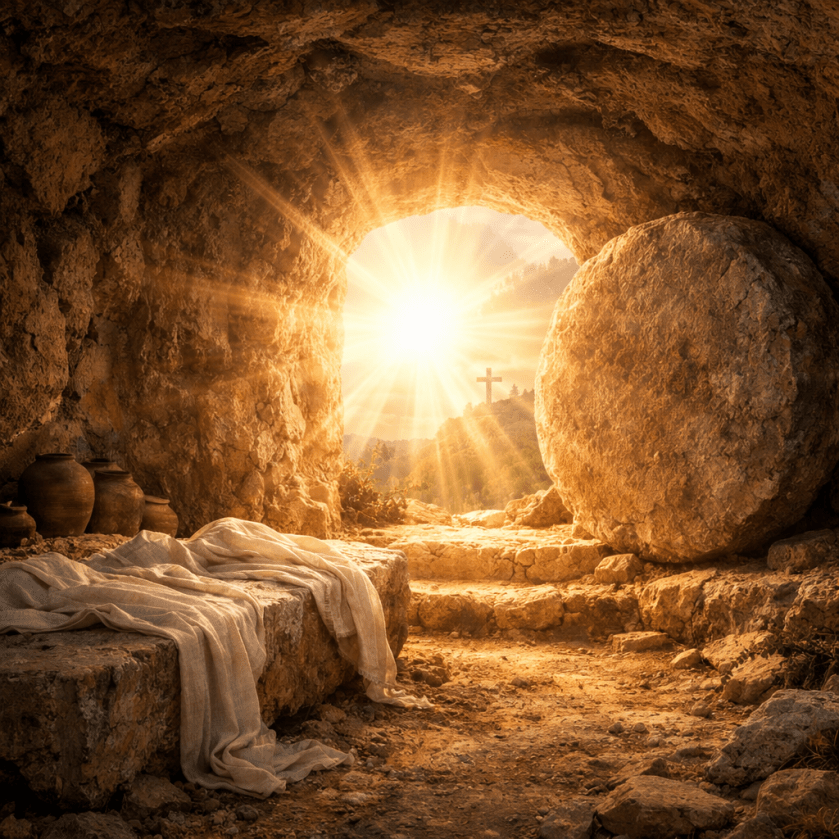
Will we even notice then the powerful witness of Resurrection in which Jesus conquers all that holds us confined within the limits of our fallen humanity? Will we be able to see that Jesus already promises a transcendence that can’t be matched by even the greatest of intelligences, one so powerful and all-encompassing that what dazzles us now will be considered as nothing by comparison? Why does Jesus spend 40 days in Resurrection with us before ascending to the Father? Precisely to get us to see, to strengthen our faith, to encourage us to go beyond our paltry imaginings into the mind of God. If we believe everything Jesus tells us, especially about the Resurrection, then we have to think very differently about these developments, and it is important to do so now because things are changing quickly.
In many respects, AI is poised to become a kind of secular sacrament for the masses. Brain-computer interfaces rooted in AI have the potential for both good and bad. The greatest danger will be the subtle suggestion that AI can replace God, who would be needed less and less as AI offers solutions at multiple levels. One can easily see certain kinds of rituals developing that would have definite religious overtones. Think of neura-link type AI replacing, in people’s minds, the indelible mark of Baptism in the soul; and think of the indwelling of the Most Holy Trinity being replaced with the microchip, the insertion of an active deposit of superior intelligence within us, the “indwelling” of an intelligence that has a mind of its own? This would be an abomination beyond argument.
Because of our fallen nature, we linger by the Tree of the Knowledge of Good and Evil instead of the Tree of Life. Most people, not thinking it through, may find the temptation to unlimited knowledge irresistible when it’s offered to all. They may not see how this could subtly dismantle Christianity by posing as a savior that ultimately usurps the space meant for God and our souls alone.
In the Incarnation, Jesus tells us there is something good, very good, about being human…It’s worth redeeming! In Person! And it’s worth glorifying. Jesus paid an immeasurable price to do this for us. In fact, His love saves us from all that dehumanizes us and elevates us to the fullness of what it means to be human.
AI, on the other hand, insists that being human is not enough. It’s too limited. Is there a possibility that AI could lead us to surrender the very thing that makes us human and the very way we transcend the obstacles to becoming truly human? And what do we become if we reject our own humanity, our own creaturehood?
In the light of the Resurrection, we find answers and true transcendence for humanity. Will we become the Bride of the Lamb or the machine? Will we trade our souls for easy knowledge, or surrender to infinite love and eternal life? This divine transformation leads to breathtaking encounters with God, far beyond anything AI can offer. In the divine light, AI remains mere child’s play when we see it for what it really is.
- What personal challenges do you have with technology?
2. Why is it that the more “prosperous” or well-provided for we are, the more we tend to distance ourselves from God instead of seeing everything as His blessing and provision in our lives?
3. How can you protect yourself from the seductive appeal of “unlimited” knowledge and power?
4. What do you think are the distinguishing marks of being truly human? And what is particularly under threat, what aspects of our humanity, with the development of AI?
 Facing Our Immortality